

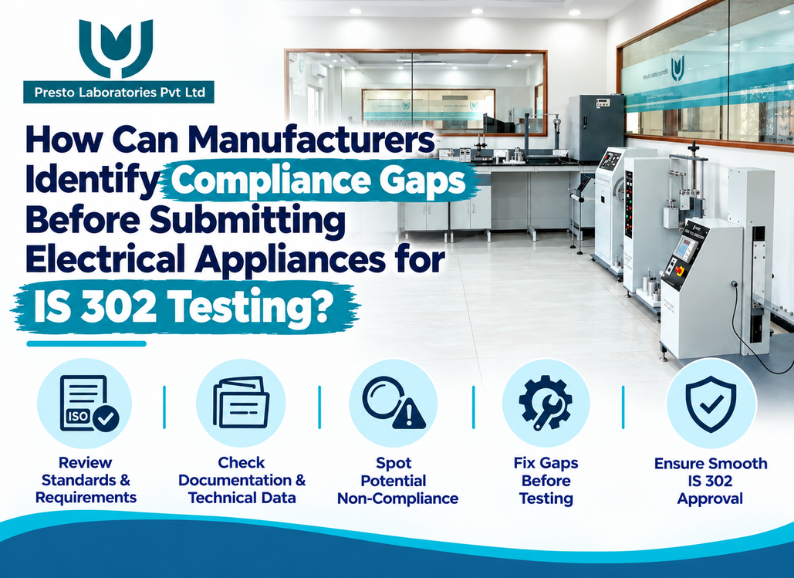
Electrical Appliances Manufacturers have to consider the safety, design, and performance of their products prior to subjecting the products to testing. This is because it becomes easy to eliminate chances of product failure through such early identification of problems. It is therefore possible for electrical appliance manufacturers to have their products tested by using an IS 302-2-7 Testing Lab in Delhi NCR. One can contact Presto Laboratories regarding the testing and preparations required for evaluation of the electrical appliance. IS 302 is a standard that deals with the safety of household and similar electrical appliances. Different parts of this standard address the safety of particular types of electrical appliances. For instance, IS 302 (Part 2/Sec 7) deals with special requirements for washing machines and spin extractors.
Manufacturers are recommended to be certain of what standard, version, and testing range they will adopt before the test. The electric equipment can be operational upon usage, yet it might face some issues regarding safety, such as insulation, wiring, temperature, mechanical strength, and selection of components. This is the reason why there is a need for a pre-compliance assessment for identification of such weaknesses in a product.
A pre-compliance check allows the manufacturer to find out if the appliance is appropriate for the test. In other words, while the test report can be used to know the problems, the manufacturer is able to look into the appliance before testing it. A pre-compliance check will come in handy especially when introducing a new appliance, changing the old one, changing the supplier, or changing the manufacturing process. It is important to note that even a small change in the design can affect the safety of the product.
It is also important to realize the gaps at the early stage since it will make the coordination of roles among the team members much simpler. The design engineers, quality control team members, production team members, and compliance team members will have the same list.
Manufacturers must look into the entire appliance and not just its parts. Some possible areas that can be investigated to uncover any compliance loopholes before testing begins include the following.
Electrical safety must always be considered a top priority in all pre-compliance testing. The manufacturer should look into the insulation system, internal wiring, earthing where applicable, and clearance between live parts and accessible parts. See to it that wires are properly laid out and secured, insulation is not exposed to sharp objects, and connections are properly installed.
Manufacturers must also check the requirements of the electric strength, leakage current, and other electrical safety tests applicable to their appliances. The specific tests will depend on the type of appliance and the clauses of the applicable standard.
Heat is normally generated by electrical appliances during their normal and abnormal operation. The manufacturer needs to ensure that the heating elements, motors, wiring, switches, and other materials are suitable for the conditions of use. There is a need to ensure that the layout of the heat-sensitive materials, ventilation, and thermostatic devices is adequate. The materials that surround heat-producing elements should also be checked.
The washing machine test report evaluation needs to take into consideration various operating modes, which will include motor running and anything associated with water functions, if any, and by doing so, manufacturers will be able to know any potential thermal problems beforehand.
The construction of an appliance is critical to the safe operation of the equipment. You should look at the housing, fixing points, fastening, doors, lids, moving components, and any other part with which a person interacts while using the appliance. Check for any sharp edges, loose components, unstable design, exposure of moving components, and incorrect mounting systems. All parts must be put together safely and pose no risk when used correctly.
For washing machines and spin extractors, manufacturers should pay attention to relevant design features such as drum access, rotating parts, covers, and appliance stability. The review should reflect the requirements applicable to the particular product.
If earthing is needed for protection, it is necessary to ensure that it has been done properly. The continuity of the protective circuit, safety of terminals, and proper connections need to be checked. Manufacturers must also consider other protective mechanisms such as barriers, insulation systems, interlocks, and protective devices wherever needed. Even though a component is installed properly, it may not provide protection due to improper rating, connection, or positioning.
The safety of the completed equipment is somewhat determined by the choice of parts that have been utilized in the manufacturing process. The producers must ensure that the switch parts, cables, motors, connectors, and other essential parts used are proper for their designated purposes. Part specifications, suppliers' information, part rating, and associated paperwork should be maintained. Any parts that have been substituted should be evaluated for suitability.
Also, enclosures, insulating materials, and components subject to thermal and mechanical stress must be evaluated according to relevant standards. Component consistency ensures that the manufacturers achieve the desired design of their products.
A qualified testing lab will be able to assist the manufacturer in determining the testing scope, document requirements, and the technical aspects that require further review. It is especially important to choose a testing lab for IS 302-2-7 in Delhi NCR for manufacturers dealing with washing machines and spin extractors.
Manufacturers should first determine the type of appliance, model number, intended application, voltage, frequency, and other details before getting in touch with the laboratory. This will help to determine which standard and edition is applicable. The laboratory can then explain testing requirements, sample preparation, and the information required prior to testing. Manufacturers should verify the available testing services from the laboratory and not assume that all testing services are available at each lab.
Compliance area | What to review | Purpose |
| Electrical safety | Insulation, wiring, and connections | Identify potential electrical hazards |
| Thermal safety | Heat-generating components and protective controls | Assess excessive temperature risks |
| Mechanical construction | Enclosures, fasteners, and moving parts | Identify physical safety concerns |
| Component selection | Ratings and supplier documents | Verify component suitability |
| Technical documentation | Drawings, ratings, and manuals | Support an accurate testing process |
| Production consistency | Assembly methods and component lists | Maintain the assessed design |
Compliance of a product extends beyond its actual appliance. The manufacturers are required to ensure that the data and information relating to product evaluation are correct and conform to the product itself. Begin by looking at the product specification form. Check out the model number, voltage, frequency, input power rating, and other product-related attributes. Ensure these specifications correspond with the data on the product label and any other available technical data files. Some of the important documents related to the product include:
It is advisable that manufacturers get clear on the required documentation from the testing lab. Any missing documentation or discrepancies between the document provided and the sample can result in further inquiries. Document control is also very critical. In case of any changes in the design, it must be reflected on the drawings and parts records.
Checklist-based assessment helps you to identify the problems in an organized way. While simply relying on visual examination is not recommended, you have to appoint someone in charge of each aspect of your conformity and document the data that supports the examination. In the first place, determine the clauses of the particular standard that apply to your product. After that, examine whether your product meets those criteria. Write down the result as conform, needs fixing, or requires technical proof. For each identified deficiency, write down the problem, potential safety concern, correction needed, and responsible party.
For instance, during an inspection, a situation may be found where the wiring is placed too close to a sharp metal edge. The manufacturer can look at the wiring placement, put protective measures into place, and then inspect the redesigned unit before submitting it. This is a good preventative measure to take, but it does not mean that the appliance will pass the test. Before submission, make sure that the sample is in accordance with the approved design and in proper working order.
Some errors that may complicate the test include the assumption that passing the functional tests means that the appliance meets all the electrical safety standards. The appliance may function properly but still have issues regarding the insulation, temperature rise, mechanical protection, and construction. Another error is to change components without considering the impact of such changes on the appliance. Such things as a new switch, cable, motor, or protective equipment might have different characteristics. Lack of proper documentation is also another error. Such things as wrong models, old circuit diagrams, or specifications that do not correspond with the actual sample could hinder product evaluation.
Manufacturing companies should make sure not to refer to the provisions of the wrong version or edition of a standard. It is important that manufacturers get clear about what provisions should apply as early as possible to ensure that unnecessary preparations and tests are not carried out in respect to the wrong scope. Any internal check shall not replace the testing process.
Identifying compliance gaps before the submission of an appliance for IS 302 testing will help the manufacturer in making better design decisions, improving quality controls, and minimizing the chance of rework that could have been avoided. A thorough review of electrical safety, temperature control, mechanical construction, parts, and technical documentation will give a better starting point for the assessment process. An IS 302-2-7 testing lab in Delhi NCR will be able to guide the manufacturer on the testing requirements for the electrical appliances.
Manufacturers need to determine the correct standard to which their product should conform, carry out a documented gap analysis, fix any problems found, and make sure that the sample conforms to its technical records. Where expert advice would be useful, talking to a laboratory about what you want to accomplish through the tests could be beneficial. Presto Laboratories could be contacted to discuss the applicable requirements for testing and assistance in electrical appliance testing. Make sure of all these before you submit your product for testing.
IS 302 testing tests the safety performance of household and similar electrical appliances in respect to the Indian Standard. The testing is done to assess the risks that can arise from electrical insulation, temperature, mechanical construction, and protection aspects.
Pre-compliance tests are necessary for manufacturers, as they will help them identify any safety issues, solve design issues, test the components, and gather technical data before testing.
IS 302 (Part 2/Sec 7) is related to certain safety requirements for washing machines and spin extractors.
It is necessary to take into account insulation, wiring, protective earthing, temperature control, mechanical structure, component compatibility, and technical documentation of the appliance.
This will depend on the appliance and the nature of the tests and could require specifications of the products, circuitry diagrams, technical drawings, component details, users’ manuals, and previous test results when needed.




 Talk to Us
 Book a Test
 Drop a Query